Labels

Showing posts with label Projects. Show all posts

Wednesday, December 11, 2013

IED Activity 4.1- Puzzle Cube Design Challenge

Introduction
Have you ever looked at a product that has been well-designed? Do you find yourself asking questions such as, “How did the designer think of that idea?” or “What is involved in the creation of that product?” The more you study and learn about design and how designers create items, you begin to learn certain skills and knowledge that you can only acquire through experience. Design challenges provide opportunities to apply skills and knowledge in unique and creative ways.

Taking an idea you have and transferring it from a concept to a sketch, to working drawings, to models, and then to a working prototype is exciting and fun. It also entails several steps. When you are a one-person design and build team, the task of effective communication is rather simple. However, what happens when you must communicate your ideas to others, or when the responsibility for building a team’s solution falls on someone else’s shoulders? This increases the level of responsibility significantly and requires the development of a complete set of design documentation in order to communicate effectively.

This project will provide you the opportunity to exercise your creativity and develop your sketching and modeling skills, as well as your ability to use the computer as an efficient communication tool.

Equipment
Engineering notebook
Pencil
27 – ¾ in. hardwood cubes
27 – interlocking plastic centimeter cubes (optional)
Paper towels
Isometric grid paper
Orthographic grid paper
Markers (colored pencils or paint are optional)
Wood glue
Sandwich-sized Ziploc® bag for storage
220 abrasive paper
Computer with 3D CAD solid modeling software

_____________________________________________

STEP 1: -Define problem (including a design brief)


STEP 2: Generating Concepts
               -Brainstorming (including part possibility configurations)
               -Research (including applied statistical analysis)


STEP 3: Develop a Solution
               -Explore possibilities (develop two different puzzle cube possibilities, and use isometric drawings, sketch out all three levels of cube)
               -Developing a design proposal (create a multi-view drawing for each piece of the chosen cube [including an isometric sketch])


STEP 4: Construct and Test a Prototype
               -Physical prototype 
               -Prototype packaging 
               -Virtual prototype (see step 6)


STEP 5: Evaluate Solutions
              -Test, evaluate, and redesign (answer the following questions: Why is it important to model an idea before making a final prototype? Which assembly constraint(s) did you use to constrain the parts of the puzzle to the assembly such that it did not move? Describe each of the constraint types used and explain the degrees of freedom that are removed when each is exhibited.


STEP 6: Present Solution (include drawing files created on Autodesk Inventor). Include:
             1.Title Page
             2.Parts List/Exploded View
             3.Assembly Page
             4.Individual Parts Page (All 5 Pieces)


IED Design Challenge- Paper tower

Goal of Challenge:
   -Create the tallest tower that can hold a tennis ball and can withstand the highest level of wind

Limitations:
   -Must be at least 18" (from bottom of ball to surface of table)
   -Must hold up against wind for at least 10 seconds (Ball cannot fall, tower cannot tip)
   -Must use only designated materials
   -Tower must be FREE STANDING (cannot be fastened to table by any means [ex. Tape])

Materials: 
     •1 school newspaper
     •3 pieces of computer paper
     •2 pieces of cardstock
     •2 feet of masking tape
     •5 rubber bands
     •1 tennis ball (cannot be modified)
     •1 pair of scissors (for use during construction only, cannot be used in actual structure)
     •1 ruler/scale (for use during construction only, cannot be used in actual structure)


     Above are steps 1-6 of the design process, applied to this activity.


IED Activity 1.8: Paper Bridge (Instant Challenge)


Introduction

Solving a problem is an amazingly creative process. Creativity can be messy. However, creativity can be channeled into a meaningful solution by using a structured design process. In this activity your team will design a solution to a problem using an engineering design process. You will document the process in your engineering notebook.


Equipment
·         Engineering notebook
·         Pencil
·         ¾ in. wooden blocks (2)
·         1 sheet of 8 ½ x 11 in. cardstock
·         Assorted construction tools such as scissors


Procedure
1.    Follow the direction of the teacher while completing this activity.
2.    Use the design process learned earlier in this lesson. Document each step in your engineering notebook. 
3.    Design and build a product that maximizes the distance between two blocks which are connected by a continuous route of paper. The product must meet the constraints below.
a.    The paper must form a continuous chain of connectivity from one block to another without touching the tabletop.
b.    Paper-to-paper linkage will be considered continuous.
c.    The two wooden blocks are ¾ in. wooden blocks.
d.    Both blocks are at table height.
e.    Card stock can be modified.
f.     Additional material can be used during construction, but not on the final product.
4.    The winning design meets the constraints above with the blocks farthest apart.


IED Activity 1.4: Product Improvement


Introduction
Hummers®, iPods®, cell phones, clothes, and video games are just a few products that are familiar to most people. What is it about any of these products that you like? What causes you to want to buy a cell phone or an IPod? Is it the commercials or the appearance of the product? Whatever the reason, design plays a vital role in the creation and marketing of any product.


Equipment
·         Paper
·         Plain white coffee cup (1 per class) OR alternate consumer product
·         Pencil


Procedure


This activity is designed to provide an introduction to design. As a team of two, you will brainstorm ways to enhance or change a plain white beverage container so that nearly every consumer would want to purchase it. Remember to apply the rules for brainstorming that were identified in the PowerPoint during this activity. The following list is available to guide your team through this activity:
·         Assign a recorder and a speaker for your group.
·         Brainstorm for five minutes with your team to identify enhancements or changes that you would make to the item. The recorder will make a list of all ideas mentioned in those five minutes. Changes or enhancements could be anything; you are not limited by cost.
·         After five minutes, select ideas to enhance or change the item from the brainstorming list.
·         For the next ten minutes, each member of the team should develop and sketch a potential change or enhancement to your product.
·         Your team will take five additional minutes to develop a justification for each potential change to the item.
·         Your team speaker will present your changes to the class.


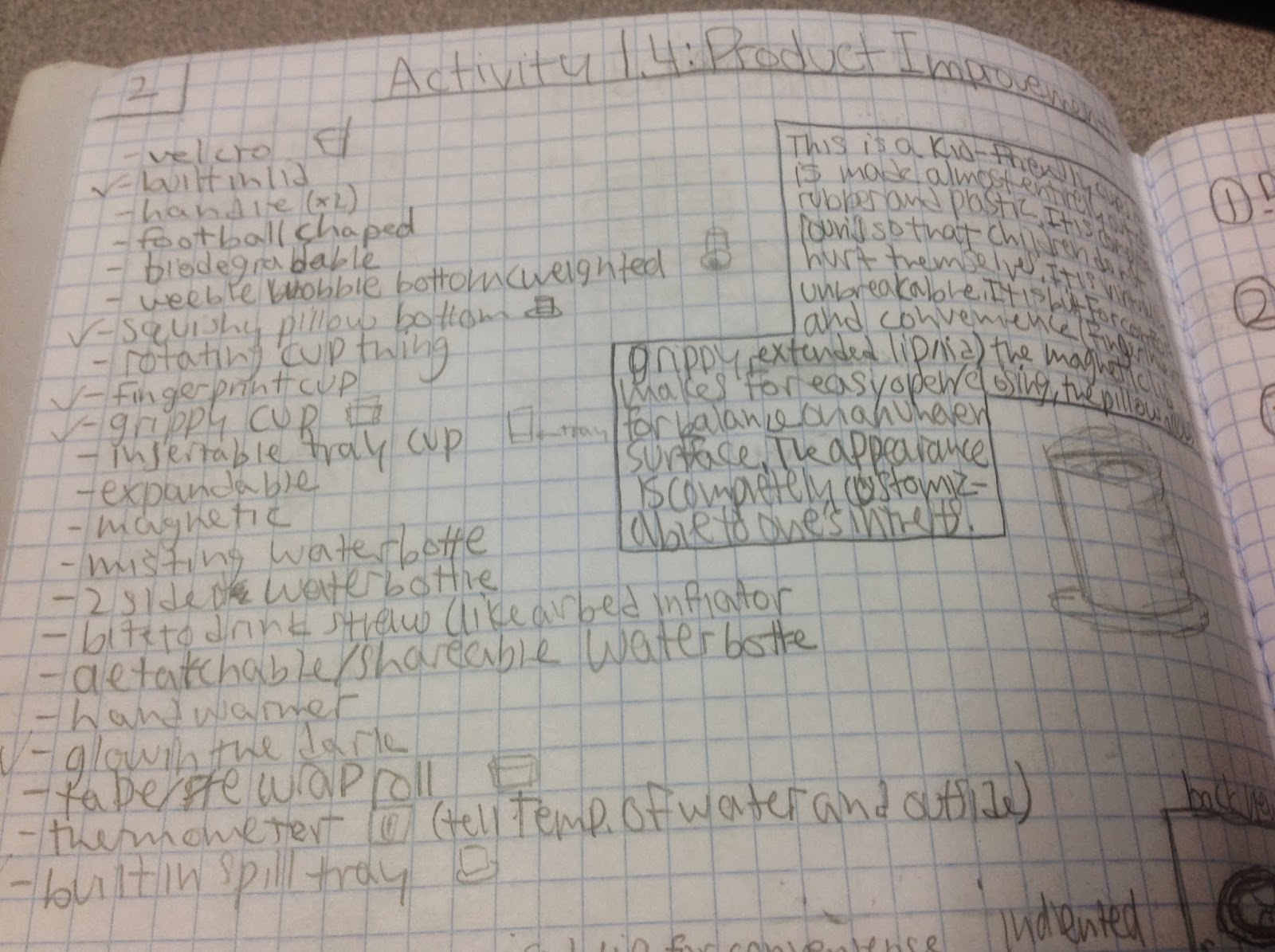
     Located above is an image snapped out of my engineering journal. The list on the left side is a list that I and my partner, Sarah, brainstormed. It was a list of problems we both thought constantly occurred with everyday cups/water bottles that should be remedied immediately.
     On the right is merely a paragraph in a box summing up generally what our cup/water bottle would be about (including details on what made it different from other cups/water bottles).

     Located below is a sketch of what our cup/water bottle would look like, if we had the time and resourses to create a prototype. The larger view on the left is a zoomed out view of the whole cup/water bottle, along with annotations for the additional functions. in the upper left, there is a smaller sketch of what the back view would look like and the three boxes in the bottom left are of the specialized lid of the cup/water bottle and what alterations we made to it.